

A Decade of Building Global Road Safety Leadership Capacity
Maryland, USA – In 2016, the very first Global Road Safety Leadership Course (GRSLC) offering was delivered by the Global Road Safety Partnership (GRSP) and Johns Hopkins – International Injury Research Unit (JH-IIRU).
The course was designed to bring together a diverse group of professionals to equip them not only with technical knowledge but also with the confidence and skills to lead change in road safety.
Ten years on – and 18 courses later – the impact of that initial effort has grown significantly.
In 2026, this evolution reached an important milestone with the official launch of the Global Road Safety Leadership Institute, building on a decade of capacity building and expanding the programme’s long-term vision. The Institute includes all leadership development programmes, from the flagship GRSLC in Baltimore, USA, and regional courses for senior government and policing leaders, to the alumni fellowship programme that fosters ongoing engagement and peer learning. Read more about the Global Road Safety Leadership Institute.
Over the past decade, this collaboration, supported by the Bloomberg Philanthropies Initiative for Global Road Safety (BIGRS), has helped shape a global community of road safety professionals working to address road traffic deaths and injuries, one of the world’s most urgent and preventable public health challenges.
With 1,160 alumni from 84 countries, the course has brought together committed professionals working to enhance the delivery of road safety in their respective regions, sectors, and disciplines. Participants have come from a diverse range of backgrounds, including government agencies, non-governmental organizations, academia, media, and development partners.
To support the programme since its inception, GRSP has consistently drawn on its global network across government, police, civil society, and research to bring real-world experience into the classroom. This complements the academic rigour brought by our partner JH-IIRU.
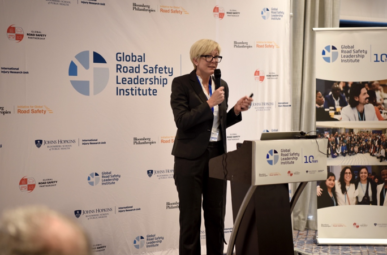
GRSP Global Programme Manager Dr Britta Lang delivering a session at the 10th Global Road Safety Leadership Course
As Dr Britta Lang, GRSP Global Programme Manager, puts it: “What makes this course unique is the combination of global evidence and real-world experience. We are not just sharing what works, but more importantly, we are working through how these solutions can be applied in very different country contexts, especially where resources are constrained.”.
Building the Next Generation of Road Safety Leaders
In 2026, GRSP and JH-IIRU welcomed 63 participants from 21 low- and middle-income countries where road traffic injuries remain a leading cause of death, and where strong, effective leadership in road safety can make the greatest difference.
This year’s Global Road Safety Leadership Course began with a focus on risk factors for road traffic injuries, setting a strong technical foundation for participants to understand how to address speed and drink driving and promote the use of helmets, seatbelts, and child restraints.
Sessions on speed management reinforced a simple but powerful truth: small reductions in speed save lives. Discussions explored practical measures – from self-enforcing road design to risk-based speed limits – that can be adapted across different settings.
Other sessions focused on key challenges:
- Road policing deterrence principles and the most effective ways to change road user behaviour to make people safer.
- Powered two- and three-wheeler safety, with a focus on helmet standards and the risks posed by substandard products.
Across these topics, the message was consistent: effective legislation, road policing, and standards are essential, and must be evidence-based and implementable.
From knowledge to influence
The course also focused on how change happens.
Participants explored policy processes, advocacy strategies, and real-world case studies, including Argentina’s efforts to amend the Traffic Law and lower urban speed limits from 40 km/h to 30 km/h for streets and 60km/h to 50 km/h for avenues as part of broader road safety reforms. Through roleplay and group work, they practised making the case for change, which often takes place in challenging political and institutional environments.
GRSP CEO David Cliff emphasised this point: “We know what works in road safety. The real challenge is getting those measures adopted, implemented, and sustained. That’s why building leadership and advocacy skills is crucial to get safe systems implemented.”.
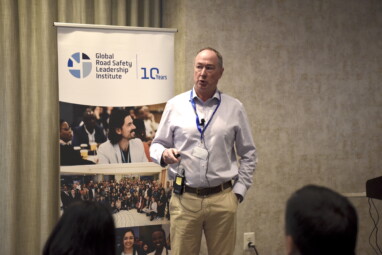
GRSP CEO Dave Cliff welcoming participants to the course during orientation
This theme carried through sessions on road policing and behaviour change, where participants examined how trust, deterrence, and behavioural science all play a role in shaping safer road use.
Participants also worked in teams on a two-week group project, designed to mirror real-world challenges. Tasked with addressing road safety crises of fictional countries, they examine complex issues, identified priority actions, and developed strategies to reduce the road trauma burden.
Along the way, they learned to navigate both individual and group dynamics, building an understanding of their own strengths while working collaboratively across disciplines and perspectives.
The project culminated in a market-style pitch, where teams presented their proposed approaches to sustainable casualty reduction and competed to convince faculty and other participants of the feasibility and impact of their strategy to address road safety.
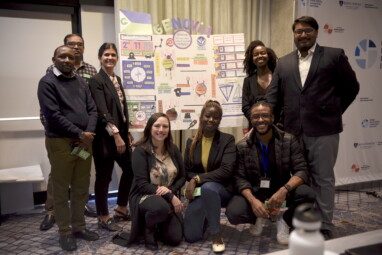
Participants presenting their group work on the final day of the course
A truly multidisciplinary challenge
One of the strengths of the GRSLC is that it reflects the full complexity of road safety. Over two weeks, participants engaged with topics including:
- Data and evidence
- Safe infrastructure design
- Vehicle safety and crash testing
- Gender and road safety
- Leadership and collaboration
The takeaway was clear: road safety is not a single-sector issue, and it cannot be solved with single-sector solutions.
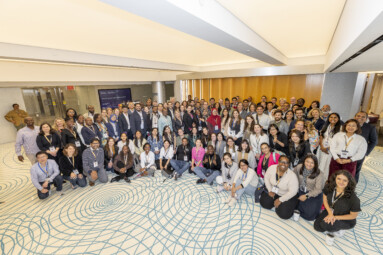
The 10th GRSLC cohort in New York City
Seeing impact in action
A highlight of the programme was the visit to New York City, where participants connected with partners from the Global Designing Cities Initiative, New York City Department of Transportation, and New York Police Department. Participants also heard from course alumni who presented on their fellowship road safety projects and personal growth as road safety leaders. These moments brought the bigger picture into focus: this is not just a course, it is part of a growing, global effort.
Looking ahead
With the 2026 cohort, the leadership institute has now trained 1,223 alumni from 86 countries, forming a network of professionals well-positioned to drive change in their own systems. As the course wrapped up with final presentations, graduation, and a well-earned celebration, it also marked a moment to reflect on what 10 years of partnership has achieved and what remains to be done. Over the past decade, the GRSLI suite of courses has helped build a global network of leaders who are applying their learning to strengthen road safety policy, advocacy, enforcement, and programme implementation in their own countries. Their work demonstrates how investing in leadership can translate into meaningful action to save lives and prevent serious injuries on the world’s roads. Read more about the achievements of GRSLC alumni.
Road traffic injuries continue to disproportionately impact low- and middle-income countries, where 92% of the world’s fatalities on roads occur even though these countries have only 60% of the world’s vehicles. Building leadership capacity, grounded in local realities but connected to global expertise, remains critical.
10 years in, the Global Road Safety Leadership Institute, continues to evolve, but its purpose remains the same: to equip people with the tools, knowledge, and confidence to make roads safer, where it matters most.
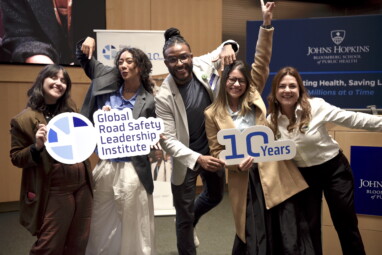
Participants celebrating at the reception following their graduation ceremony